
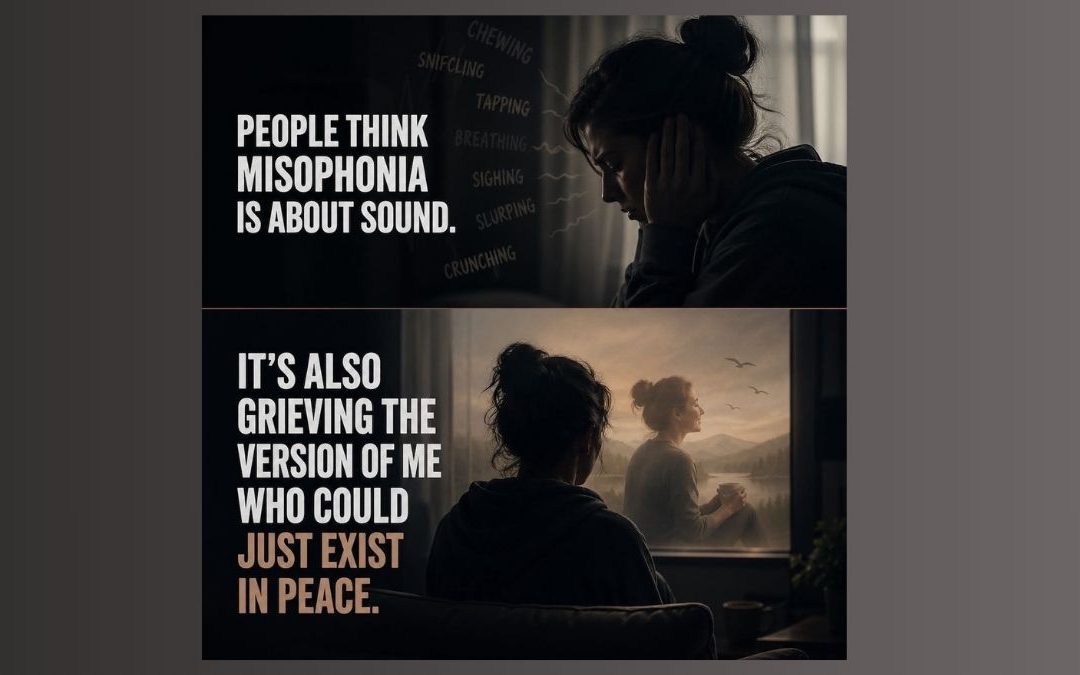
Grief, inflammation, and nervous system tension—what role do they play in misophonia? And why do some treatments help while others fall short? Two professionals from different continents explore these questions and share validating realities in a wide-ranging conversation hosted by the Misophonia Association.
In the free May 3 online clinic, Adam Bucklow of CampMindblocks joined Marsha Johnson, audiologist and association founder. Together, they took a deep dive into the theme, “Exploring Misophonia,” engaging in topics that included validation, treatment theories, anticipatory anxiety, injustice misophonia, trauma, success, well-being, and auditory memory. Bucklow is a hypnotherapist specializing in trauma, misophonia, grief, and related areas.
I first heard about Bucklow in a parenting misophonia group many years ago. His work had a strong reputation, but because he was in England and I was on the West Coast of the United States, he felt out of reach. When Dr. Johnson invited him to join our May clinic—after being drawn to his infographics on Facebook—it felt like a meaningful opportunity for the misophonia community.
Having been on this misophonia journey with a family member for more than six years, I didn’t expect their conversation to offer so many new ideas—but it did. After the clinic, attendees shared overwhelmingly positive feedback, reflecting a high level of engagement:
“This was the BEST clinic yet.”
“It was so informative. Feels so good to meet people who understand.”
“I greatly appreciated the way in which Adam talked about unconscious processes.”
“I don’t know if I should refer to you as heroes or angels, but regardless, the way you help and touch lives is invaluable.”
Those were just some of the responses shared. Below are 13 stand-out validating realities of living with misophonia pulled from the clinic conversation, along with the context that made them impactful.
“Many people have called me over 29 years, and the first words on the phone are, I thought I was crazy.” – Dr. Marsha Johnson
Context: Bucklow had described his single trigger, and there was a question as to whether having only one trigger could be considered misophonia. Dr. Johnson reiterated that it could and went on to describe how she has received many calls over the years from people who were relieved to learn that what they were experiencing was actually a “thing.” She acknowledged throughout the clinic that there is still so much that is unknown or misunderstood. The condition has been historically misclassified as hyperacusis, a psychological issue, or a behavioral problem, for example. People have been misunderstood or dismissed for their reactions.
Having misophonia and feeling isolated is, sadly, a common thread throughout the community. Clinic attendee Paula, who has lived with the condition for 60 years, felt that exact resonance. “I always thought that I was alone because I didn’t understand what was wrong with me. Around 25 years ago, I was able to put a name to it, but I never had what I most wanted: a community of people with whom I could feel safe. I came across the Misophonia Association and began attending their free clinics,” she said.
“I think, to a degree, living with misophonia is living in exposure therapy. And therefore, if exposure therapy helped us, we would all be cured, right?” – Adam Bucklow
Context: Dr. Johnson described the changing landscape over the decades and how exposure therapy was very popular at one time. Bucklow shuddered at the thought of having to relive his own trigger. Dr. Johnson continued, saying that it was truly a torment many people endured under false expectations for far too long. Bucklow agreed, adding that he has known the practice to worsen outcomes for individuals.
“We don’t hate the sound as much. We hate the way it makes us feel.” – Adam Bucklow
Context: With this comment, the conversation took a dive into the term “misophonia,” which means hatred of sound. Neither presenter found the term appropriate to describe the condition. Bucklow elaborated on the psychological layers of the condition, noting that patients often struggle with their own reactions, the anxiety of anticipating a sound, and even purely visual triggers. While the term is relatively new, Dr. Johnson first identified the condition in the 1990s after noticing hundreds of audiology patients exhibiting the odd symptoms. She coined the term selective sound sensitivity syndrome, or 4S.
“I don’t believe it’s the sound or the visual that bothers the nervous system as much. It’s more the anticipatory anxiety about the thought of the sound.” – Adam Bucklow
Context: Continuing with this thought on what happens behind the sound, Bucklow described how much a person’s anxiety can build by simply seeing, for example, a bag of unopened chips. Whether the chips are eaten or not, a lot of energy, anxiety, and adrenaline are wasted without a sound. He calls this a “ghost soundtrack” that plays in people’s minds. Just thinking about the trigger can be enough to elicit a response.
Hypnotherapy comes into play here, as it addresses the part of the mind that is unconscious. Bucklow explained, “The part of the mind that created this wasn’t conscious and therefore the part of the mind that is going to add some value isn’t going to be conscious either.” He loves to teach his clients to use the havening technique to regulate their nervous system. (This concept was also discussed at the January clinic with Dr. Jaelline Jaffe and Sara Barrick.) Dr. Ronald Ruden, and his brother Steve, introduced this psycho-sensory therapy that uses gentle touch.
“Trauma is essentially a wound on the psyche…it’s totally subjective. One person’s trauma might not be traumatic to somebody else.” – Adam Bucklow
Context: Bucklow gave the example of a car accident. It could devastate one person, while another might roll their eyes and complain about the traffic delay. For trauma to take root in the nervous system, Bucklow said four components must be present: an event that disrupts equilibrium, a personal meaning attached to it, an altered emotional state, and a feeling of inescapability (e.g., being trapped at the table or in a car). When all four components occur simultaneously, Bucklow said the mind takes a screenshot for memory and storage in the amygdala. Now that memory is there for life unless it is intercepted and changed. This state can be applied to misophonia; however, not everyone has trauma at the root of their condition.
This excerpt on trauma was enough for attendee Tao to share, “I just want to say that through this conversation, I was able to identify the trauma source for my misophonia! Thank you.”
“We think about misophonia as a neurological condition. I think there’s an emotional component to it as well… Is it exclusive to everybody? No, it’s not, and that’s why it just makes this such a complex maze.” – Adam Bucklow
Context: Bucklow described the trauma that is rooted in his misophonia, followed by his approach. He assists clients in finding a root cause (if applicable) and gives them tools to help regulate their nervous system to get themselves “back to baseline quicker.” He’s satisfied when his clients tell them that they can no longer hear the ghost soundtrack. When their mental tension is reduced, people tend to have lower levels of adrenaline and cortisol and higher levels of serotonin and oxytocin. Bucklow said finding these levels of internal safety is the key. Self care is also important since people are more prone to being triggered when they are tired, angry, hormonal, or hungry.
“I just want somebody to understand that we’re dealing with a stubborn part of the brain.” – Adam Bucklow
Context: Results and strategies vary from person to person. Bucklow feels that clients who resolve trauma first have promising improvement. Feeling betrayed by someone and not expressing it is trauma, as is anything unresolved. These feelings increase anxiety and cause the nervous system to be out of balance.
“There are a lot of people convinced they have the answer, and that it is the only answer.” – Dr. Marsha Johnson
Context: There are many different treatment approaches, which is why Dr. Johnson initially struggled to invite “the experts” to the Misophonia Association’s annual convention. No single person has the answer for everyone. She’s fascinated–and hopeful–by the expansion of research.
“I’ve looked in every corner of the room, trust me, and this thing would be characterized, I think, as an inflammatory response, because of the rapidity of the response, the intensity of the response. It’s not a cold paralytic response.” – Dr. Marsha Johnson
Context: Dr. Johnson suggested that the rapid and intense nature of misophonia reactions may point to an inflammatory component. Supporting this possibility, Bucklow shared a story of a client who responded well to therapy while taking anti-inflammatories and regressed when she stopped. He emphasized that reducing inflammation should be paired with somatic retraining of the nervous system, as he believes success may be limited if inflammation is not addressed.
“I’m convinced there’s almost like an allergic reaction to a person’s energy.” – Adam Bucklow
Context: This comment came during a discussion about whether there are different types of misophonia. Bucklow described injustice misophonia, where a person is triggered by someone who has wronged them or by unresolved emotional tension. When the injustice is resolved, he has seen the trigger disappear. Finding the root cause of the injustice misophonia can be incredibly powerful. It might trace back to a specific moment of forced silence, like enduring someone sniffling at a funeral, or it could be the cumulative weight of growing up in a toxic household.”
Later, there was a question about misophonia being a symptom of something larger–sort of the reverse of this first thought. The conversation circled back to all of the current theories and the need to label things. Everyone’s experience is real. Bucklow feels that qualitative data is better than quantitative data. If a person is able to sit with someone they haven’t been able to in years, that’s priceless, he said.
“We have unbelievable auditory skills as humans. This is why you have people with dementia who can still sing songs they knew as a 3-year-old, but they can’t talk. But the music, the tones, the thousands of frequencies where you can receive. We have giant storage areas for auditory memories. They are almost impossible to displace. They don’t disappear.” – Dr. Marsha Johnson
Context: The comments relate back to the power of memory in the brain.
“The aim of the game is to find internal safety, making the nervous system feel like it’s had its voice, and raising our understanding and awareness about what’s actually happening inside. I think understanding is power.” – Adam Bucklow
Context: Bucklow said success with a client isn’t always easy to define. It could be sitting with family, getting back to baseline quicker, or going to a movie. Like trauma, healing is subjective. Bucklow’s ultimate goal is to make his services obsolete. Right from the start, he asks his clients what they want to achieve, focusing entirely on giving them the tools they need so they eventually won’t need him at all.
“There is this tremendous amount of grief in these families, the constellation of the family, I call it. The family gets misophonia. There’s a lot of grieving with looking at this as a lifetime situation or a problem that might be around for a long time.” – Dr. Marsha Johnson
Context: People take a lot for granted, mourning the loss of “life as it once was” before misophonia. The condition does not define a person. It’s just a part of them. There is hope, and there is room for improvement if that mindset is accepted instead.
While many questions remain in the world of misophonia, Dr. Johnson’s and Bucklow’s discussion offered thought-provoking perspectives for anyone seeking a deeper understanding of the condition. At the conclusion of the clinic, Bucklow shared a couple of his infographics. One of them is used as the featured image for this blog.
To experience the full conversation between Dr. Johnson and Bucklow, watch the recording found under the Online Clinics menu or visit the Misophonia Association’s YouTube channel.
Recent Comments